
 Artist · Author · Choreographer
Selected Visual Practice2-D
Painting · Photography · Illustration
Visible
/ Invisible
A visual practice concerned with consciousness, incarnation, spiritual perception, and the unseen structures of experience.
Navaji David Nava is a queer Mexican-American interdisciplinary artist from South Texas working across light-responsive mixed-media painting, photography and conceptual portraiture, and illustration. Across these forms, the image becomes a threshold: a way of translating inner perception, cultural memory, symbolic experience, and states of consciousness into visible form.
Enter the work ↓
Selected practice 01
A sustained visual language
Image as
threshold.
The work does not separate spiritual inquiry from material practice. Pigment, light, portraiture, symbol, and narrative become different ways of approaching the same question: how can inner experience be made visible?
Navaji’s paintings use acrylic, mixed media, UV-sensitive pigments, phosphorescent material, metallic powder, and sand. His photography uses light, direction, gesture, costume, and environment to construct images around archetype and inner identity, while his illustration carries the same cosmological vocabulary into narrative form.
This is a research-informed practice shaped by comparative spiritual study, scenic and visual-design training, decades of embodied performance, and independent studio experimentation. Across media, the work returns to perception, belonging, transformation, and the dignity of inner life.
Practice at a glance
A visual language
with a larger life.
The work is presented here through six recurring markers: material distinction, sustained research, cultural position, public presentation, independent recognition, and service to others.
Light-responsive painting and directed photography both use illumination as structure: one reveals hidden material states; the other constructs atmosphere, archetype, gesture, and psychological presence.
Painting is informed by scenic art, fabrication, comparative spiritual study, embodied practice, mythology, philosophy, and ongoing written research.
A queer Mexican-American artist from South Texas, Navaji works toward images of sacred and human identity expansive enough to hold lives often left outside inherited visual traditions.
Painting has been presented through Big Medium’s Austin Studio Tour and encountered directly by audiences in a public studio context.
Conceptual photography has been featured internationally, while illustration and interdisciplinary visual practice have received independent critical response.
Teaching, youth exhibitions, publication, mentorship, and audience encounter extend the practice beyond the studio into community life.
Identity · place · reverence
“I believe the highest goal of art is to connect our soul to our divine nature — and that sanctity is the birthright of all beings.”
Belonging
made visible.
For Navaji, representation includes the spiritual imagination.
Growing up in the Rio Grande Valley and moving through the world as a queer Mexican-American artist, he has often searched for images expansive enough to hold people who are rarely centered within inherited cultural, artistic, or sacred narratives. His work does not attempt to illustrate one doctrine. It draws from comparative religion, esoteric study, mythology, lived experience, and inner perception to build a more inclusive visual language of the sacred.
That inclusivity extends beyond human identity. Land, natural forms, elemental color, animals, atmosphere, and cycles of light are approached with reverence rather than used as scenery alone. The work begins from a conviction that interiority, dignity, and the possibility of the sacred are not privileges granted by an institution; they are innate qualities of being.
Natural light · ultraviolet light · phosphorescence
Paintings
that change.
Research thread perception · luminosity · hidden states · material transformation
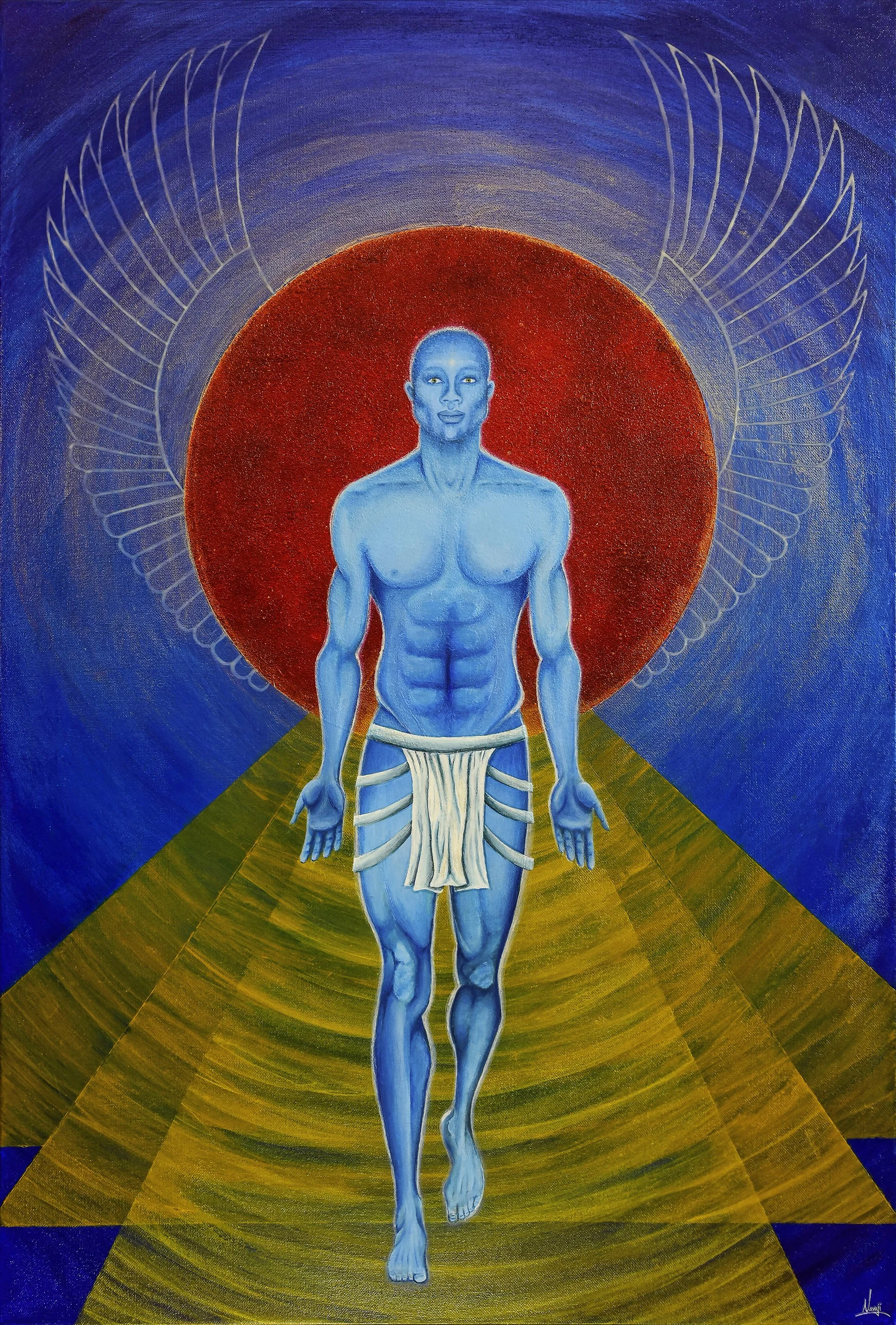
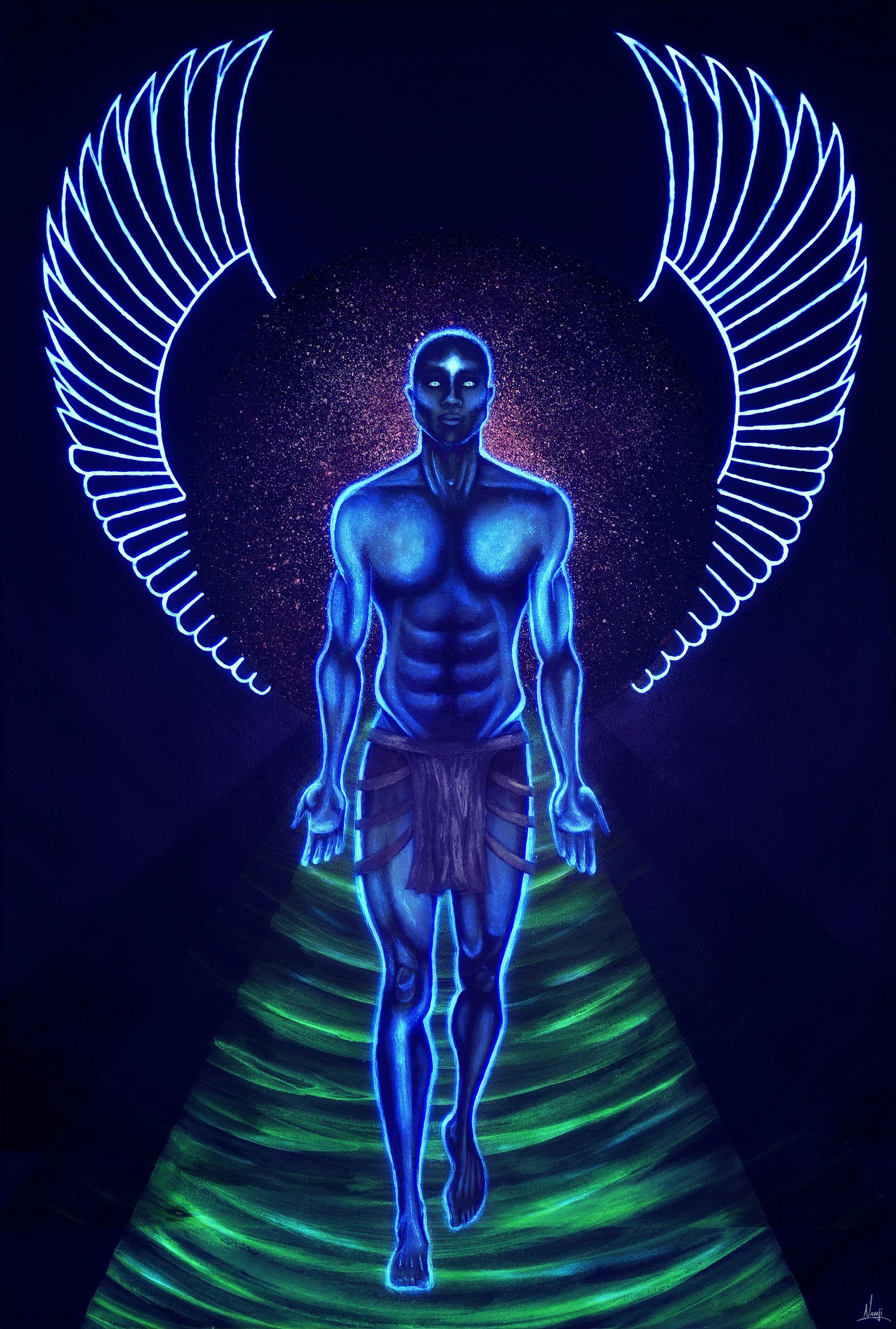
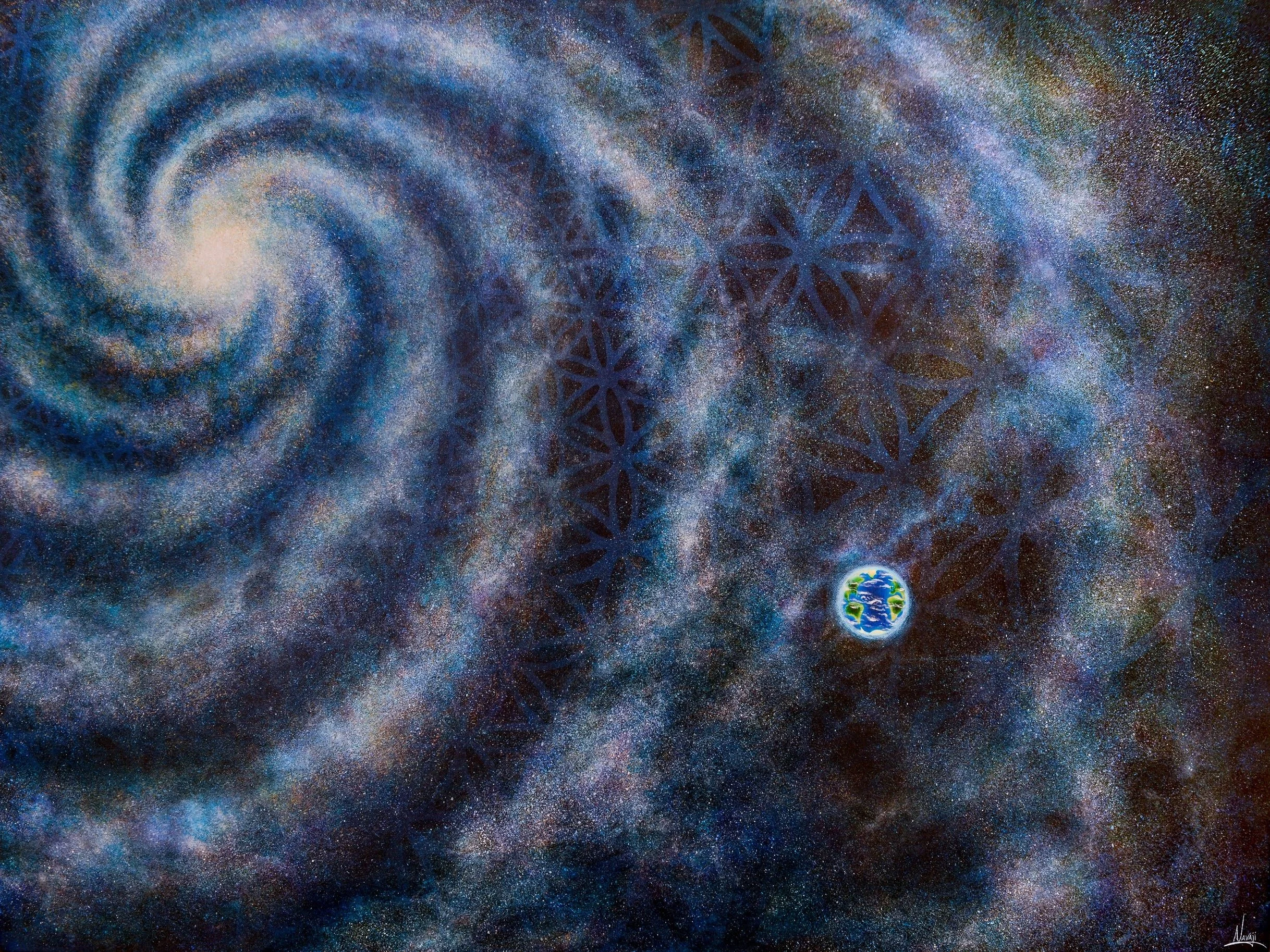
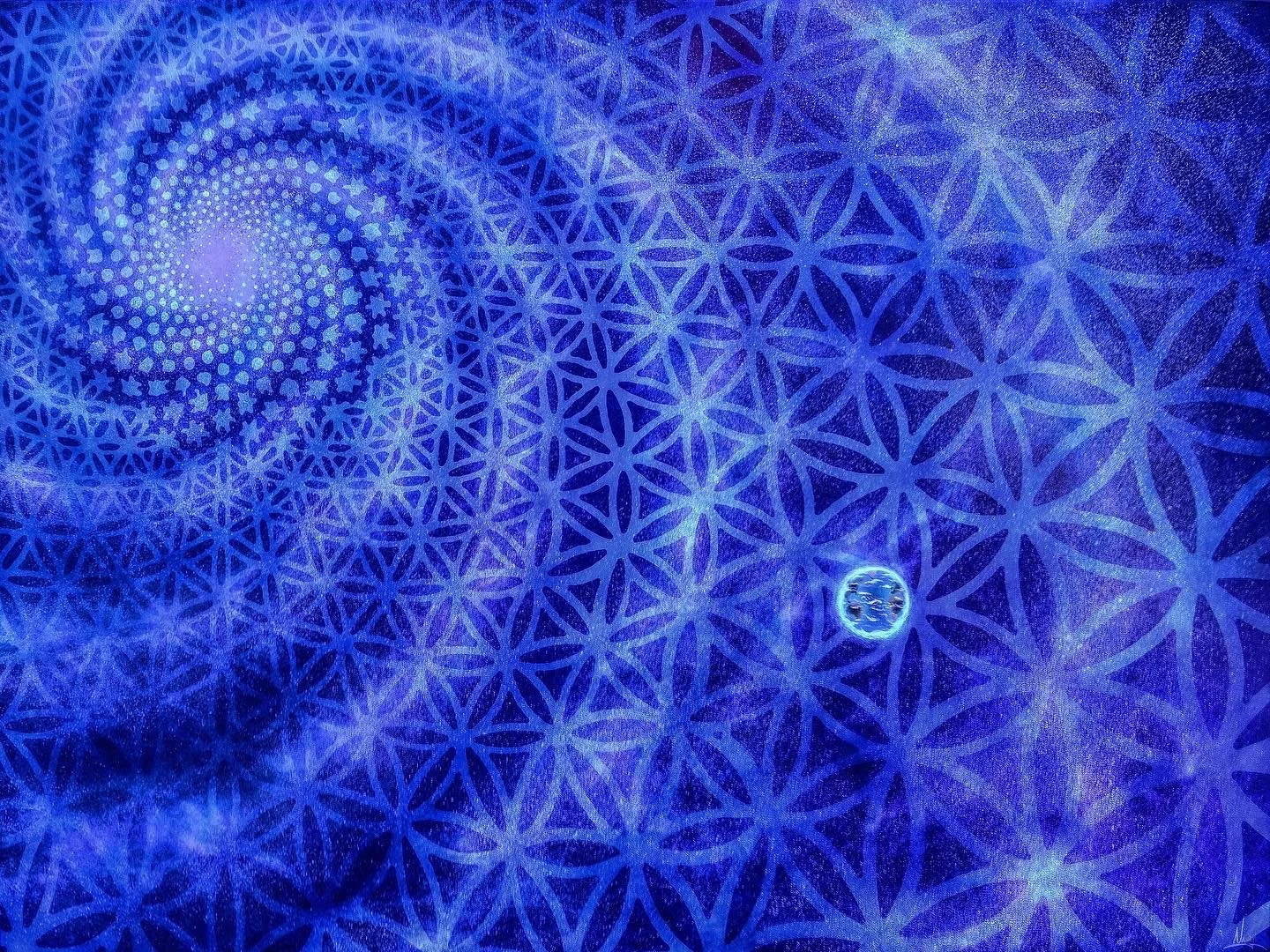
A single canvas can contain more than one visible state.
UV-sensitive and phosphorescent pigments are embedded into the works themselves. As illumination changes, forms emerge, disappear, intensify, or recede. The shifting image is not a reproduction effect; perception and light are part of the material structure of the painting.
Choose a light state beneath each work.
Light Work 01Mixed-media acrylic, UV & phosphorescent pigment on canvas · 24 × 36 in.
The Powers


Light Work 02Mixed-media acrylic, UV & phosphorescent pigment on canvas · 24 × 36 in.
RA
Light Work 03Mixed-media acrylic, UV & phosphorescent pigment on canvas · 36 × 48 in.
Satori
Light Work 04Mixed-media acrylic on canvas
Kalkin Chakra
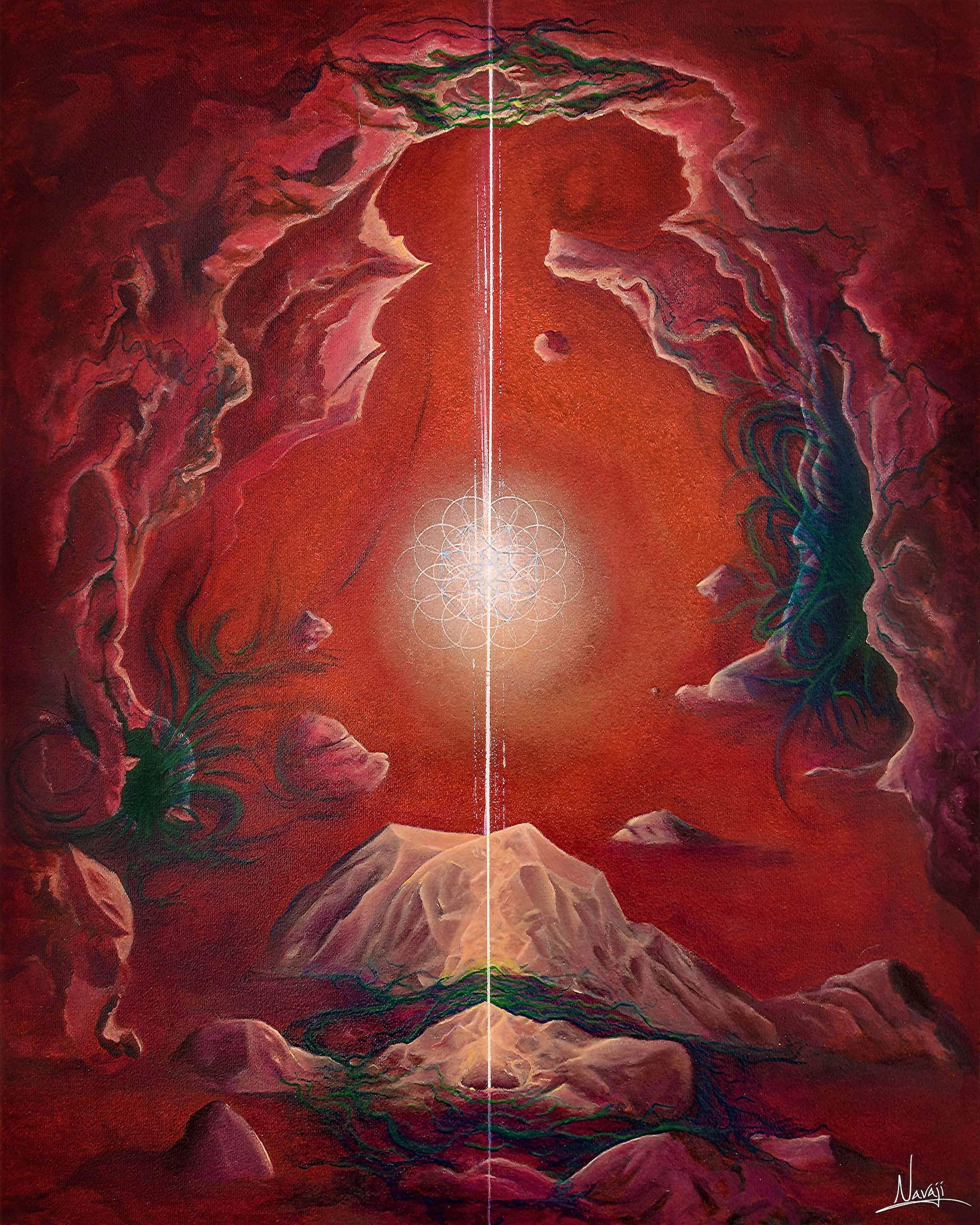


Selected paintings
Beyond the light-responsive works, recurring forms move through Navaji’s painting practice: beings, thresholds, geometric structures, elemental fields, and symbolic presences situated between abstraction, vision, and myth.
Research thread comparative mythology · symbolic geometry · nature · subtle perception
Cosmologies
in color.
Perceptual studies · painting as record
Astral
Studies
Some works begin not with a composition, but with an observation Navaji is trying to remember accurately enough to paint.
Navaji describes Astral Study I and Astral Study II as records of clairvoyant energetic observation. Color, luminosity, geometry, and spatial relationship are used to translate a subjective subtle-perception experience into a visible image.
The emphasis is not on requiring a viewer to adopt a metaphysical claim. It is on the artistic discipline of translation: observe, retain, compare, research, and give an interior perception a material form that another person can encounter.
Research thread subtle perception · observation · memory · energetic form · translation
Photography · Portraiture · Direction
The eye
behind the lens.
Research thread light · archetype · gesture · identity · environment · direction
An image is not merely taken. Its essential nature is witnessed, directed, and called forth.
Navaji approaches photography as an act of direction—the same practice through which he constructs a theatrical world, composes a canvas, or guides a performer toward the truth of a role.
Technical theatre taught him how light, texture, costume, gesture, and space can transform perception. Painting taught him to recognize the architecture of an image before it exists. His spiritual and humanitarian practice taught him to look past appearance toward essence. Behind the camera, those disciplines converge.
Illumination is used to shape psychological atmosphere, reveal form, and direct attention rather than simply expose a subject.
Gesture, styling, costume, location, framing, and movement are composed as parts of one image-world.
The goal is not disguise. The portrait heightens something already present—dignity, humor, grief, sensuality, power, or spiritual presence.
Years inside dance and performance inform how Navaji reads posture, weight, line, timing, and the expressive intelligence of the body.
Collection 01 · Ongoing
ATMA Artist
The everyday becomes archetypal.
ATMA Artist is an evolving conceptual portrait series devoted to the essential character within a person. Friends, artists, and collaborators are translated into images that recall modern deities, saints, mythic beings, and enduring archetypes.
The work is especially important within Navaji’s larger practice of belonging: sacred or mythic imagery is not treated as the possession of one body, culture, gender expression, or inherited ideal. Portraiture becomes a way to widen who may be pictured inside dignity, mystery, beauty, and the sacred imagination.
Publication feature
ATMA Anthony
Conceptual portraiture becomes evidence of reach as well as method. ATMA Anthony was featured in 2020 by Objetos con Vidrio, an international Spanish-language publication devoted to contemporary glass art and related visual culture.
Commissioned practice
Direction applied
to a public identity.
The same visual intelligence can operate inside a commission without losing authorship.
For The Burn Room in downtown Austin, Navaji created portraits and campaign imagery translating physical rigor, intimacy, heat, and the studio’s atmosphere into a coherent editorial world. The commission demonstrates another dimension of the 2-D practice: the ability to move from personal symbolism into a defined public brief while retaining a recognizable command of body, color, lighting, and image direction.
Scope portraits · campaign imagery · social/editorial image-making
01 / 07
Use the arrows, keyboard, or swipe to move through the campaign archive.
Current visual research · work in progress
What Makes
Wings
A finished image becomes the beginning of another question.
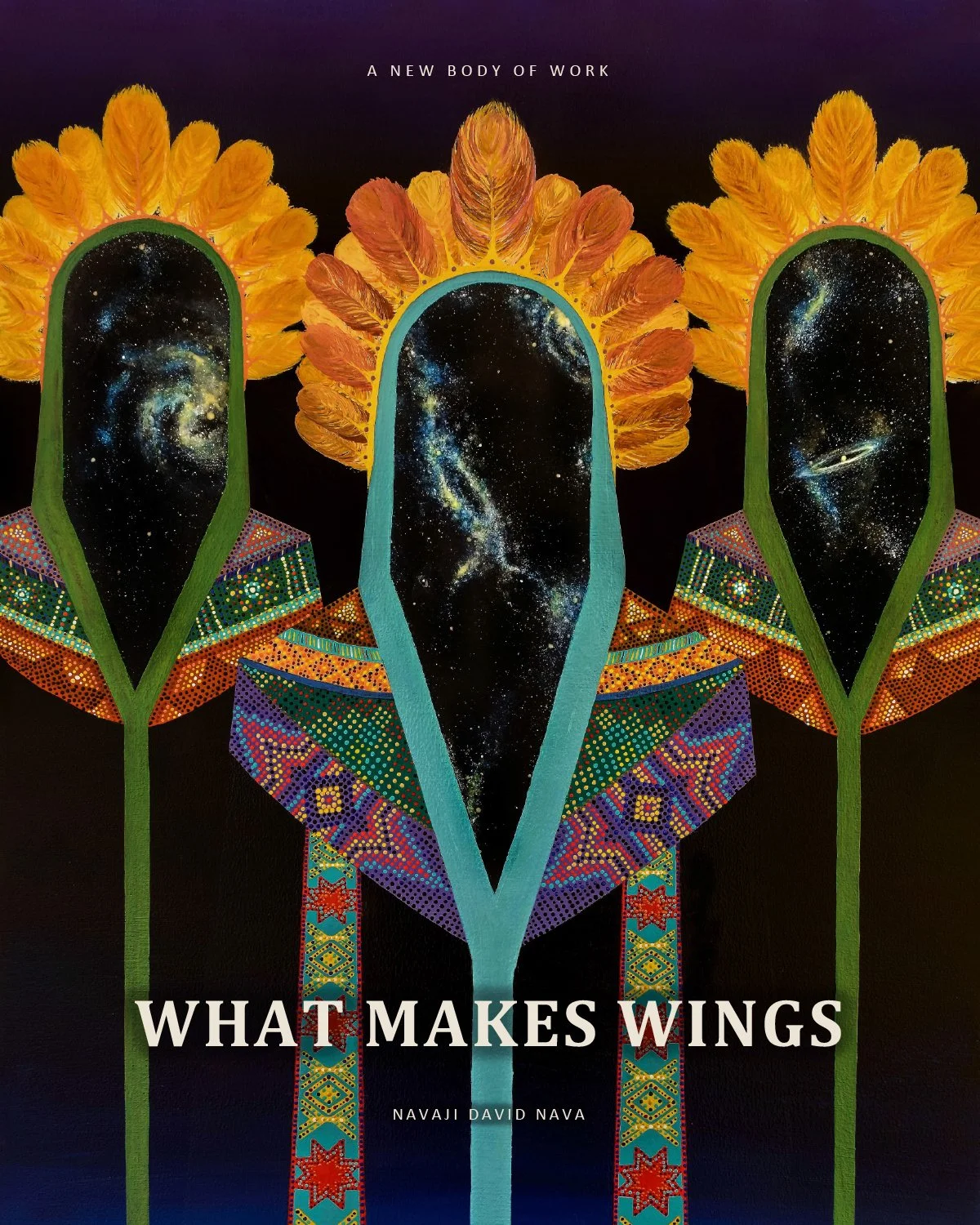
What Makes Wings extends from the symbolic world of The Powers into an evolving inquiry around transformation, ascent, weight, longing, and the architecture of becoming. On this 2-D page, the project appears only as evidence of continuity: a glimpse of how Navaji’s visual language continues to generate new research rather than ending at the edge of a canvas.
The fuller costume, spatial, and embodied development of the project belongs to Navaji’s three-dimensional practice. Here, the emphasis remains on the originating image, symbolic research, and the visual questions still unfolding from it.
The practice behind the image
Study made
material.

The paintings emerged from sustained study rather than from a single stylistic exercise. The studio image at left documents Navaji developing another canvas within the Light Works inquiry.
Navaji’s visual language has developed through independent studio experimentation, scenic-art and fabrication training, comparative spiritual study, clairvoyant observation, movement practice, mythology, and sustained inquiry into consciousness.
University training with Karen L. Maness and J.E. Johnson expanded his scenic-art, fabrication, environmental-rendering, and visual-production vocabulary. His principal spiritual and philosophical mentorship with Anthony Cowan, alongside further study with Greg Toews and Professor Robert Temple, informs the conceptual field from which the work emerges.
Independent painting practice alongside university study in scenic painting, environmental rendering, visual storytelling, and fabrication.
Principal mentorship with Anthony Cowan, with additional study under Greg Toews and Professor Robert Temple.
Decades of professional dance training inform Navaji’s understanding of the body as both material form and instrument of perception.
The Rio Grande Valley, borderland belonging, cultural plurality, and the search for inclusive images of human and spiritual identity remain central to the work.
Ongoing written research
ATMA Moves
A Philosophy of Conscious Movement, Energy & Sacred Motion is a book-length manuscript in development through which Navaji continues to articulate the philosophical ground beneath his visual, embodied, and spatial work.
Imagination is treated as an intermediary field where unseen meaning begins to gather into image, movement, word, or action.
Color, shape, image, fabric, sound, proportion, and placement are approached as active participants in how a work is received.
Reverence means meeting a person, place, tradition, or living being without reducing it — recognizing dignity, mystery, and relationship before possession.
The body is understood as one of the places where consciousness becomes visible through form, discipline, gesture, and presence.

Illustration & publication
The cosmology
enters narrative.
Research thread soul · incarnation · death · belonging · wonder
The visual language of the paintings continues through A Soul’s Life, where metaphysical ideas become accessible through image and story.
Written and illustrated by Navaji, the book translates questions of incarnation, inner identity, death, belonging, and consciousness into full-page digital imagery for children and families. The aim is not simply to explain an idea, but to offer young readers a visual world in which the soul is approached with wonder rather than fear.

Education · encounter · cultural stewardship
Art as
relationship.
The practice is not complete when an image leaves the studio.
Navaji’s work has developed alongside teaching, youth arts advocacy, public presentation, artistic mentorship, and direct encounter with viewers. The same values that shape the images — dignity, curiosity, reverence, and the possibility of transformation — also shape how he works with people.
As an Austin ISD visual-art teacher, Navaji taught more than 600 K–5 students, developed interdisciplinary curricula, and created annual Youth Art Shows that treated children’s work as worthy of serious public presentation.
For the KOMOREBI Youth Art Show, students were guided through proposal development, selection, creation, curation, and public presentation — experiencing art as participation in a larger cultural process.
Through A Soul’s Life, complex questions of death, incarnation, inner identity, and consciousness are translated into image and story for children and families.
Through the Austin Studio Tour, publication, books, performances, and public-facing visual projects, the work moves into lived encounter — inviting reflection on consciousness, identity, land, belonging, and inner life.
Public presentation · publication · criticism
The record
beyond the studio.
This section separates self-description from outside evidence: where the work has been presented, published, encountered, or independently reviewed.
ATMA Anthony · Objetos con Vidrio
Big Medium · Austin Studio Tour
A Soul’s Life · Book 1: The Soul
Visual and interdisciplinary work reviewed by CTX Live Theatre
Selected public presentation within Austin’s citywide studio-tour platform, placing Navaji’s self-directed painting practice in direct conversation with local audiences and the wider Texas arts ecosystem.
ATMA Anthony featured by an international Spanish-language publication devoted to contemporary glass art and visual culture.
Independent critical response by David Glen Robinson addressing the book’s illustration, visual language, and multimedia character.
Read review ↗Feature-length criticism documenting Navaji’s visual, scenic, costume, installation, and interdisciplinary practice — evidence that the visual language extends beyond the frame into complete environments.
Read review ↗Broader professional artistic record
A life built
inside the arts.
The visual practice exists within a larger professional career spanning performance, choreography, design, education, and artistic leadership.
These experiences are not presented as substitutes for the 2-D record. They are the wider artistic ecology from which it has developed — decades spent studying form, composition, body, audience, image, discipline, and the responsibilities of making work in public.
International ballet representation as a young artist placed Navaji’s professional formation in an international artistic context from the beginning of his career.
Professional classical repertory and company life established an early standard of rigor, repetition, visual precision, and artistic discipline.
Assistant Director and Resident Choreographer, with artistic work spanning choreography, scenic design, costume, photography, coaching, and production development.
Visual-art education brought Navaji’s artistic values into daily relationship with hundreds of young people and their families.
An evolving visual practice
The image is
still becoming.
The medium changes. The inquiry continues.
Across painting, photography, portraiture, illustration, writing, movement, education, and environment, Navaji continues to develop a visual and embodied language for the same enduring question: how can what is inward, unseen, or difficult to name be given a form that helps another person recognize something more fully in themselves and in the world?
Rooted in South Texas and developed through a life of professional artistic practice, the work remains oriented toward belonging, disciplined perception, cultural inclusion, and reverence for the inner life shared by people, land, and living beings.
All artworks, photographs, and illustrations © Navaji David Nava. No reproduction, redistribution, or derivative use without written permission.